01
Intake
Catch the work as it arrives.
A service email reports a leaking unit but omits the equipment identifier. The request becomes a tracked task.
Operations agents
Agents should move bounded work through approved tools and permissions, with clear failure paths and human ownership when the stakes rise.
Inside the workflow / Illustrative example
A service request is classified, checked for missing information and escalated with the context a person needs.
Intake
A service email reports a leaking unit but omits the equipment identifier. The request becomes a tracked task.
01
Intake
A service email reports a leaking unit but omits the equipment identifier. The request becomes a tracked task.
02
Triage
The agent classifies the request as maintenance and retrieves the approved intake procedure.
03
Uncertainty
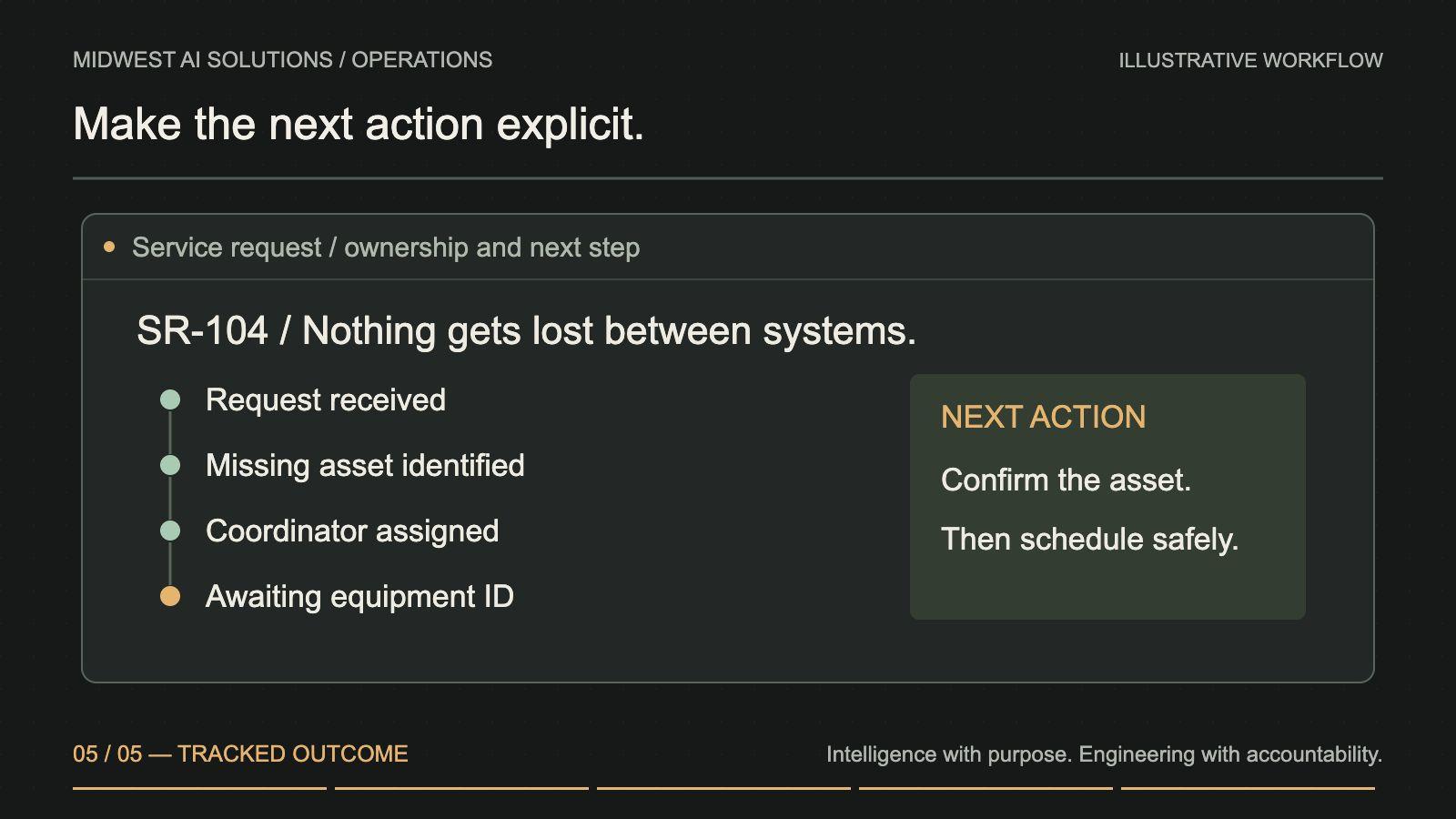
The equipment identifier is required. The agent holds scheduling and prepares a clarification instead of guessing.
04
Human handoff
A coordinator receives the original request, missing field and proposed follow-up. The handoff preserves the work already done.
05
Tracked outcome
The task is assigned to the coordinator with an awaiting-information status and a recorded reason.
What we engineer
Intake and triage, ticket handling, CRM updates, reporting, research, quoting, task generation, follow-up, and internal support.
Email and calendar workflows, API calls, database updates, browser actions, and human approval for destructive or high-risk steps.
Source context, citations, audit logs, exception queues, named owners, and evaluation against the actual workflow.
Start with proof
We map the work, test model and capacity requirements, design the controls, and define a practical implementation.